When the Prevention of Sexual Harassment (POSH) Act, 2013 was enacted, it marked a defining step in the history of workplace legislation in India. For the first time, employers were bound by law to create environments where dignity, equality, and safety were not aspirational values but enforceable rights. Since then, organizations have complied in varying degrees: policies have been drafted, Internal Committees formed, POSH compliance programs and awareness sessions conducted. Yet, even after more than a decade, we often hear of the same gaps, employees who hesitate to report, committees that falter on timelines, leaders who see POSH as an HR formality rather than a cultural imperative.
The persistence of these gaps raises a simple but urgent question: whose responsibility is it to make POSH programs effective? The answer is not straightforward, because responsibility is neither singular nor uniform. It is collective, yet it demands clear allocation. And it requires not only procedural compliance but also sensible budgeting, practical negotiation, and above all, a commitment to dignity in every interaction.
“For POSH to truly succeed, responsibility cannot remain vague or assumed. It must be deliberately and transparently allocated across every stakeholder in the system. The employer must take ownership of building robust policies, ensuring awareness, and providing resources. The Internal Committee must shoulder the duty of conducting inquiries with fairness, sensitivity, and adherence to the law. Managers and team leaders must cultivate a culture of trust where employees feel safe to speak up. Employees themselves must recognize their role in respecting boundaries, supporting peers, and using the system responsibly.”
– says Pallavi Pareek, Founder and CEO at Ungender
The Question of Cost: Negotiating with Sense and Practicality
One of the most under-discussed yet decisive factors in POSH effectiveness is cost allocation. Too often, organizations view POSH as a perfunctory expense, to be minimized rather than thoughtfully invested in. In practice, the range of spending on POSH compliance programs we have observed is staggering, from as little as one rupee per participant to as much as one thousand rupees per participant. Such a wide variation is not just about affordability; it reveals how differently organizations perceive the value of compliance.
A one-rupee session is usually a broadcast exercise: generic slides, mass delivery, little or no interaction. It may satisfy a checkbox, but it rarely equips employees with the clarity or confidence to act when faced with misconduct. A thousand-rupee session, on the other hand, is typically led by an experienced advisor who brings real-world case handling into the room, tailors content to the company’s workforce, and creates a space for discussion and questions. The difference between the two is not just in cost, it is in credibility, retention, and impact.
Negotiating this cost is not inherently wrong. Every organization has budgetary constraints, and leaders are right to ask what they are paying for. But negotiations must be practical, not dismissive. What matters is not the figure on the invoice but the value derived from it. The right questions to ask are: Is the session contextualized to our industry, workforce, and risk profile? Does the facilitator have the practical experience of handling inquiries, guiding Internal Committees, and working with survivors and respondents? Will the session change how employees think about their responsibilities, or will it be forgotten as soon as it ends?
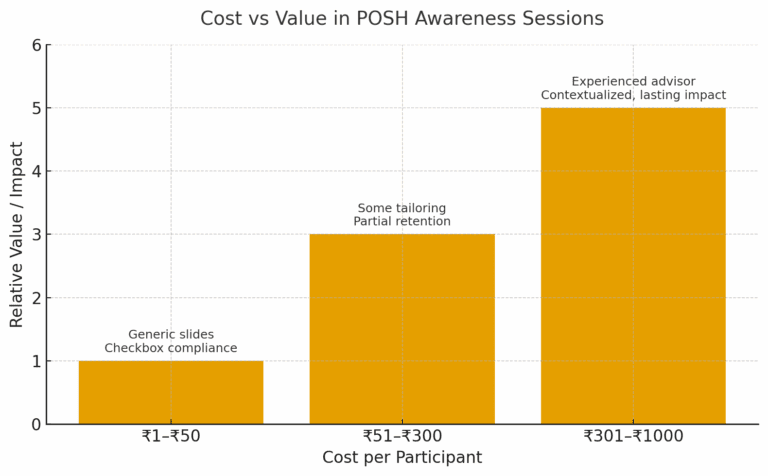
Practical negotiations can create balance without diluting quality. Organizations can structure hybrid models, where senior advisors lead critical conversations and trained facilitators deliver reinforcement modules. They can stage investments, beginning with a baseline and pilot session before scaling. They can pay for senior expertise where it matters most, such as IC training and complex case management, while adopting modular awareness formats for larger groups. What cannot be compromised is the principle that experience and contextualization cost more, but they protect more as well. A mishandled case, an untrained committee, or an uninformed workforce will cost far more in legal exposure, reputational harm, and employee disengagement than any awareness budget line ever will.
Beyond Cost: Why Experience Matters More Than Appearances
When organizations look for POSH advisors or external members, the mistake often made is to equate appearance with capability. A senior designation or grey hair may create the impression of authority, but what truly matters is not age or title, it is the depth of experience in POSH-specific work. The critical question is: how many cases has this person handled, how many Internal Committees have they guided, and how deeply do they understand both the law and the realities of workplace dynamics?
An advisor who has sat through inquiries, managed sensitive testimonies, and dealt with complex evidence brings insights that no textbook can teach. They know how bias creeps into questioning, how confidentiality can easily be breached, and how timelines and documentation make or break defensibility. This lived experience enables them to anticipate pitfalls and guide ICs through difficult situations with confidence.
By contrast, an advisor chosen only for their stature risks reducing the role to symbolism. They may falter when faced with complex inquiries, digital evidence, or power imbalances. And when that happens, credibility collapses, for the IC, for the organization, and for the law itself. Investing in experienced advisors is therefore not a matter of luxury but of necessity. What organizations are truly paying for is the wisdom that prevents errors, strengthens defensibility, and lends legitimacy to the entire system.
Dignity and Decorum: The Cornerstones of Trust
It is important to remember that POSH is not simply about compliance with legal timelines or procedural correctness. At its heart, the law is about dignity. Every stage of the process, whether it is an awareness program, a consultation between HR and leadership, or an inquiry conducted by the Internal Committee, must uphold respect and decorum.
For survivors, dignity means being heard without judgment, without blame, and without the pressure of silence. For respondents, dignity means being treated as neutral participants in the process until facts are established, not as villains in a pre-written script. For Internal Committee members and external advisors, dignity means that their work is recognized as professional and specialized, deserving of respect and fair compensation, not dismissed as a compliance burden.
The absence of dignity undermines the system at its core. If a complainant feels shamed during questioning, they will never encourage another colleague to report. If a respondent feels unfairly treated, the credibility of the IC collapses. If IC members themselves are dismissed or underpaid, the seriousness of their role is diminished, and their ability to perform with rigor is compromised. Dignity, therefore, is not a decorative value, it is a safeguard of fairness, trust, and legitimacy. Without it, even the most technically correct inquiry fails in spirit.
From Collective to Accountable Responsibility
There is a popular saying in corporate culture: “POSH is everyone’s responsibility.” While true in essence, in practice this framing often dilutes accountability. When everyone is responsible, no one is truly accountable. For POSH to be effective, responsibility must be both collective and clearly allocated.
Leadership holds ultimate accountability. Leaders are the custodians of workplace culture, and it is their role to set the tone, fund the program, and visibly support its independence. Without leadership endorsement, all other efforts are downstream compromises. Human Resources teams are responsible for operationalizing policies, maintaining records, and ensuring employees know where to go, while also maintaining the separation that allows ICs to function independently. The Internal Committee itself is responsible for inquiries: conducting them fairly, neutrally, and within timelines. They are the cornerstone of defensibility in any POSH compliance programs. External Members and advisors must bring their expertise and independence, ensuring the committee’s processes align with both the law and best practices, and stress-testing outcomes for fairness and procedural soundness.
Learning and Development teams must ensure that awareness is not a one-time annual event but a part of the organizational training rhythm, embedded into induction, reinforced periodically, and contextualized to evolving realities. Finally, employees themselves are not passive recipients. They must know their rights, respect workplace boundaries, and take ownership of reporting and supporting a culture of dignity.
When each role is clearly defined, the system functions as it was designed to. Advisors guide and provide expertise, ICs determine cases, HR operationalizes, leaders allocate resources and model accountability, L&D sustains awareness, and employees live out the culture daily. This clarity not only strengthens the system internally but also makes it defensible externally, in courtrooms or in the court of public opinion. Importantly, budgeting decisions must follow the same logic. Organizations must be willing to value expertise fairly, allocating funds where they have the highest impact, on IC capacity, on contextual awareness, and on the presence of credible advisors.
The POSH Act gave us the scaffolding. But effectiveness depends on how we build upon it. Cost, dignity, and responsibility are not side considerations; they are the foundation. When organizations under-allocate budgets, they compromise outcomes. When they choose advisors for appearances rather than experience, they weaken credibility. When they fail to uphold dignity in interactions, they erode trust. And when they treat responsibility as everyone’s role without assigning it clearly, they risk letting it fall through the cracks.
To make POSH compliance programs effective, organizations must be willing to invest, not only money, but also clarity of roles, fairness in negotiation, and respect in execution. The future of POSH lies not in paper compliance but in practice, in culture, and in lived reality. Workplaces that embrace this truth will not only meet the letter of the law but will embody its spirit, creating environments where safety and dignity are not promises but everyday practices.
That is when workplaces will be able to say, with integrity, that they are not just compliant, they are safe, fair, and truly dignified.