
How Conduct’s Timeline & Documentation Guardrails Prevent Inquiry Failures
In every workplace inquiry, the Internal Committee carries two simultaneous responsibilities: ensuring fairness in the process, and ensuring that the process itself can stand scrutiny. Even the most sincere inquiry can be questioned if timelines slip, if documentation is inconsistent, or if hearing records are incomplete. The Prevention of Sexual Harassment Act, 2013 is very…

In every workplace inquiry, the Internal Committee carries two simultaneous responsibilities: ensuring fairness in the process, and ensuring that the process itself can stand scrutiny. Even the most sincere inquiry can be questioned if timelines slip, if documentation is inconsistent, or if hearing records are incomplete.
The Prevention of Sexual Harassment Act, 2013 is very clear about timelines, communication, and documentation requirements. Inquiry failures rarely arise from bias or intent, they arise from gaps in record-keeping, delays that weren’t tracked, or inconsistencies between what was done and what was documented.
This is where timeline and documentation guardrails become the backbone of a defensible PoSH inquiry.
A system like Conduct ensures that no essential step is missed, delayed, or forgotten. It embeds legal timelines into the workflow and creates a documentation trail that is complete, chronological, and audit-ready.
This blog breaks down how inquiry failures typically happen, and how Conduct’s guardrails prevent them.
Why Timelines Matter More Than Most Organisations Realise
Every PoSH inquiry is held together by legally mandated timelines, acknowledgment of complaints, issuance of notices, hearing schedules, evidence submissions, and final recommendations. When even one of these steps is delayed, courts often interpret it as procedural unfairness.
The IC’s biggest risk is not intentional delay, it is accidental delay. Workload, multiple stakeholders, unclear reminders, or simply the pace of day-to-day operations can disrupt the inquiry rhythm. Without structured tracking, it becomes easy to lose a day here and a week there.
Under PoSH, “administrative delays” are not valid justifications. This is why defensible inquiry systems focus first on timelines.
Common Pitfalls In Inquiry Failures
A common issue that significantly undermines the fairness and defensibility of inquiries under the PoSH Act is the failure to adhere to prescribed timelines.
- Delayed notices
Delayed notices weaken the inquiry process because they often lack proper formal record-keeping and transparency, which can cause confusion and reduce trust in the procedure. IC members must ensure notices are sent timely and through official channels, not informally over WhatsApp or similar platforms.
- Rushing Through Inquiry
Rushing through an inquiry can seriously undermine its fairness and credibility. In the case of Aureliano Fernandes v. State of Goa, the Supreme Court pointed out that “the entire process was wrapped up in flat 39 days. This shows the tearing hurry in which the Committee was to submit its Report,” highlighting the dangers of concluding inquiries too quickly without giving sufficient time for a proper defense. The Court stressed that such undue haste leads to procedural unfairness because it deprives parties of a reasonable opportunity to participate and defend themselves.
- Lack of timestamp evidence
A lack of timestamp evidence showing when documents were shared creates ambiguity and questions the transparency of the process. Without clear proof of document sharing, the inquiry risks being challenged for procedural lapses.
- Delayed forwarding of complaint
Delayed forwarding of the complaint to the respondent hampers their right to prepare a defense, impacting the fairness of the process. The courts have consistently held that every stage must proceed without unjustified delays to preserve natural justice.
- Missing written intimation
Missing written intimation regarding rights, timelines, and process to both complainant and respondent adds to confusion and undermines the principles of transparency and fairness. The Delhi High Court in Arti Devi v. Jawaharlal Nehru University highlighted the necessity of proper documentation and communication, reprimanding the JNU Registrar for failing to produce complete files and stressing the importance of keeping accessible records.
- Late final recommendations
Finally, late final recommendations beyond the mandated period invite contestation. In Aureliano Fernandes v. State of Goa the court had also underlined that the PoSH Act timelines “are mandatory, not directory,” and failure to adhere dilutes the inquiry’s legitimacy. This rigid adherence ensures credibility and trust in the inquiry process.
Why Documentation Guardrails Matter
Documentation is more than just evidence; it tells the story of the entire inquiry. When documentation is incomplete, fragmented, or inconsistent, it can make even a well-conducted investigation appear flawed and vulnerable. Common gaps auditors often find include missing essential details in minutes, contradictions between different versions of the same hearing, informal communications not recorded anywhere, evidence without proper context or chain-of-custody, absence of witness statement authentication, missing interim recommendations, and no record of communications after the inquiry ends. Weak documentation creates vulnerabilities that can undermine the inquiry’s credibility, regardless of how fair or diligent the committee was in handling the case. Clear, consistent, and thorough records are vital to defending the integrity and outcomes of workplace investigations.
How Conduct Addresses Documentation Gaps to Support Internal Committees
Conduct simplifies and strengthens inquiry documentation through a range of carefully designed features that ensure nothing critical is missed and every record is credible and traceable.
That is why, Conduct offers structured templates for every stage of the inquiry, whether notices, hearings, minutes, witness statements, recommendations, or final reports. These legally aligned templates create consistency and help avoid accidental omissions, ensuring all essential information is captured clearly and correctly.
Secondly, version control is built-in to track every change made to documents such as minutes. Original drafts, edits, and final versions are all saved, preventing challenges to the integrity of records by showing a full, auditable history of updates.
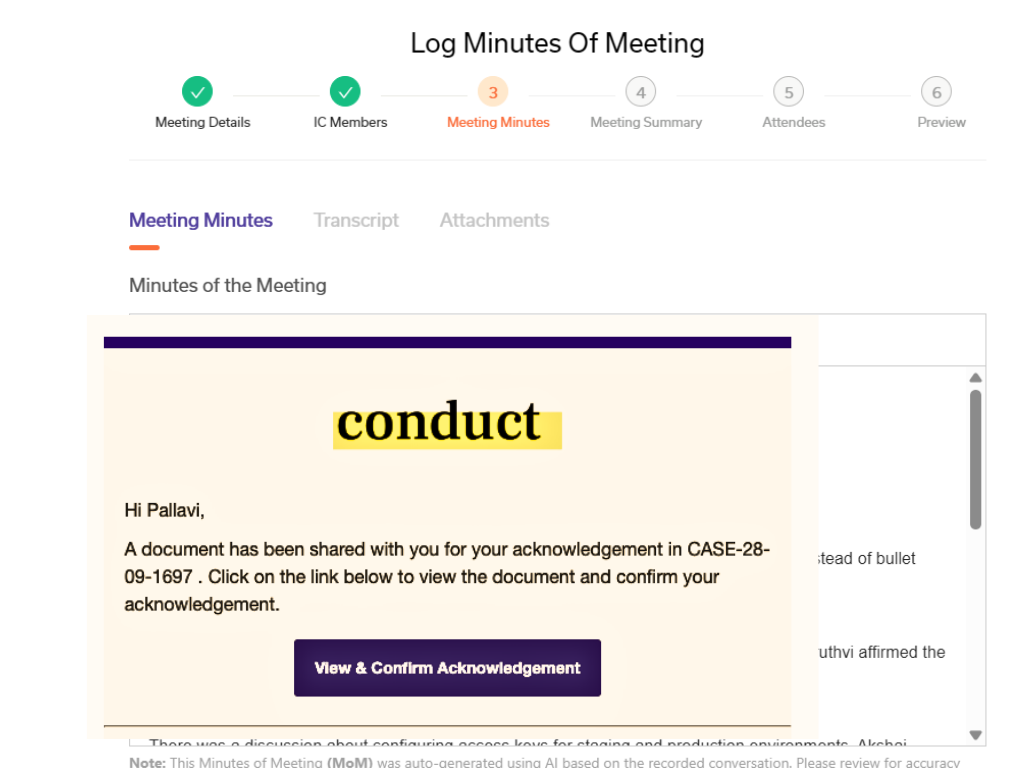
Through Conduct’s evidence vault maintains a strict chain-of-custody for all submitted files. Every file is timestamped, source-logged, access-controlled, and preserved in order. This eliminates the common problem of fragmented, scattered evidence like random WhatsApp screenshots or missing attachments.
During hearings, IC members can document notes in real time directly on the platform, avoiding the typical errors that arise when reconstructing events from memory after the fact. This immediate capture enhances accuracy and trustworthiness.
Finally, all records form one unified, chronological case file. This file clearly shows what was done, when, by whom, and whether it aligned with legal and policy requirements. Such comprehensive, orderly documentation is exactly what courts expect to see to defend inquiry outcomes.
A defensible inquiry rests solidly on two pillars: timeline integrity and documentation integrity. Fairness, neutrality, and thoroughness depend on these foundations. For IC members working under pressure, strong systems like Conduct protect their efforts by supporting timely, complete, and legally sound inquiry processes.
Explore Conduct’s infrastructure →
This approach acknowledges that workplace culture is shaped not just by leadership statements but by how processes operate in reality. A smooth, well-documented inquiry aligns with evolving regulatory expectations and employee demands for transparency and fairness without overwhelming users with jargon. The future calls for robust systems that empower ICs and HR teams alike to uphold justice and trust in increasingly complex work environments.
Key takeaways
- Most PoSH inquiry failures stem from timeline gaps and inconsistent documentation, not from the IC’s intent.
- A defensible inquiry depends on timestamped actions, structured records, and legally aligned communication.
- Conduct embeds compliance guardrails into every stage — preventing delays, omissions, and documentation inconsistencies.
Subscribe for insights that matter
Related Articles