From Report to Resolution: The Anatomy of a Workplace Case
Every case begins with uncertainty. The person reporting often fears consequences, and the person responding worries about fairness. The IC carries the weight of getting the process right. A clear workflow doesn’t just offer structure, it offers reassurance to everyone involved. Workplace case management is often viewed as a procedural necessity, an administrative channel activated…
PoSH Compliance•November 27, 2025•
432 views •By
Ungender Team
Every case begins with uncertainty. The person reporting often fears consequences, and the person responding worries about fairness. The IC carries the weight of getting the process right. A clear workflow doesn’t just offer structure, it offers reassurance to everyone involved.
Workplace case management is often viewed as a procedural necessity, an administrative channel activated when something goes wrong. But in reality, workplace case management is one of the strongest signals an organisation sends about how it treats its people. The very first response to a concern, who listens, how promptly, and with what clarity, shapes trust long before any outcome is reached.
Most inquiry failures do not happen because the IC lacks competence, they happen because small procedural lapses compound over time: a delayed notice, misplaced evidence, inconsistent minutes, unclear communication, or a missed statutory timeline.
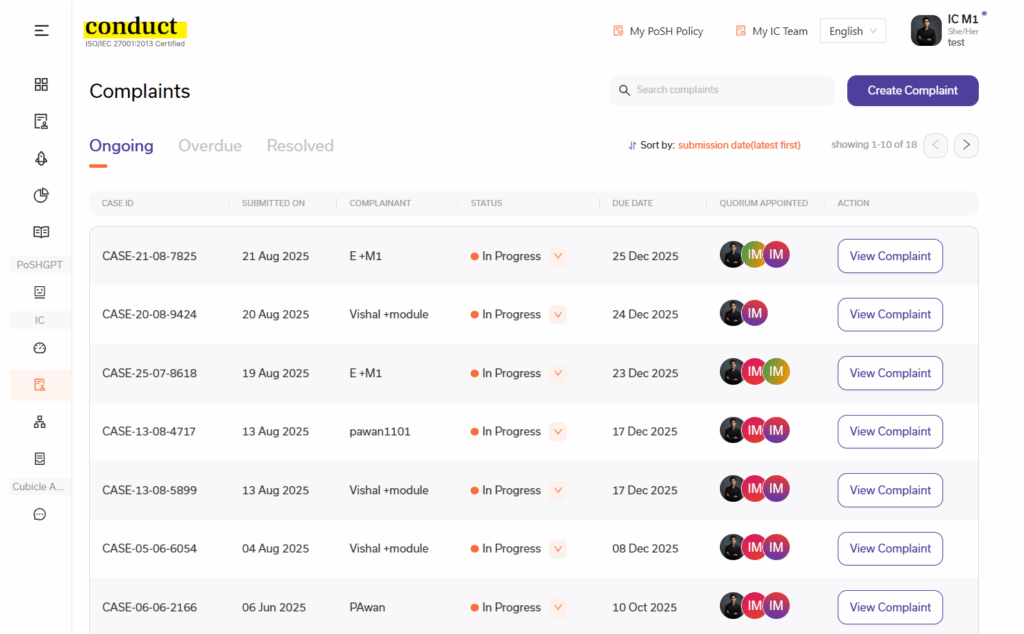
This is why every workplace needs a clear, structured, and defensible case management workflow. Below is a realistic and human-centred view of how a workplace case moves, step by step, from the moment a report is made to the point of final resolution, and how Conduct supports the IC at each stage.
1. When a Concern Is Raised: The Intake Moment
Every case begins with uncertainty. A complainant often carries the fear of retaliation, disbelief and reputational harm. While on the other hand, organisations carry their own anxiety about fairness. What organisations underestimate is how much the first moment shapes the rest.
Conduct ensures this by offering multiple channels, including anonymous reporting, and by automatically creating a time-stamped case record. From the very first moment, the organisation has a clean, defensible starting point.
2. Early Assessment: Understanding What the Case Is Actually About
Not every report is the same. Some fall under PoSH, some under general misconduct, some require immediate intervention, and others may be preliminary concerns. The IC’s task is to assess scope quickly and objectively. Conduct guides this stage with templates and prompts that keep the assessment neutral, complete, and policy-aligned, ensuring that no early assumptions colour the inquiry.
3. Notifications and Due Process: Setting the Tone for Fairness
Natural justice begins with communication. Yet this is where small lapses accumulate, delayed notices, unclear wording, missing attachments, or unrecorded delivery.
Employees today expect precision and respect in procedural communication. Notices are not mere formalities; they signal the seriousness of the process. Conduct generates compliant notices, tracks delivery, and maintains an audit log. This creates procedural clarity for the parties and structural protection for the IC.
4. Evidence and Documentation: Building the Backbone of the Case
A workplace case is only as defensible as its documentation. In modern workplaces, evidence lives everywhere, messaging apps, email threads, cloud folders, CCTV systems. The risk of loss or mishandling is high.
Conduct’s evidence vault maintains chain-of-custody, access control, and timestamping, which protects the IC from claims of bias or procedural failure. This is where documentation shifts from “files” to “defensible records.”
5. Hearings and Inquiry: Where the Story Unfolds
Hearings carry emotional weight. Parties often remember not the outcome but how they were treated, whether they were given space, whether they felt interrupted, whether the IC seemed prepared.
Therefore IC must ensure that both parties feel respected, heard, and given a full opportunity to present their case. Conduct supports this by automating schedules, standardising templates for minutes, and maintaining real-time notes during hearings. It helps the IC stay present with the parties while the system handles administrative weight.
6. Deliberation and Findings: Arriving at a Reasoned Conclusion
Deliberation is where ICs tell us they feel the greatest pressure. The expectation is not perfection but reasoned, clear thinking grounded in the balance of probabilities.
Fragmented notes and scattered evidence often create avoidable doubt. Conduct helps ICs organise timelines, link testimonies to evidence, and craft findings that reflect a coherent process, not memory-dependent reasoning. The result is not just a report but a defensible narrative.
7. Closure and Post-Inquiry Responsibilities
Once the findings are communicated, the IC’s work does not end. There are follow-up measures, retaliation monitoring, record retention, and policy-aligned actions to complete. Conduct automates reminders, secures long-term storage, and ensures confidentiality locks are in place so that closure is administratively clean and legally compliant.
Why This Workflow Matters
A workplace case is never just a case. It is a reflection of the organisation’s values, process integrity, and ability to uphold fairness under pressure. When handled well, it builds trust, not only in the IC but in leadership and culture. When mishandled, the reputational and cultural damage lingers far beyond the individuals involved.
Inquiry failures rarely arise from lack of intent. They arise from structural gaps: delayed notices, missing documentation, unsecured evidence, or misaligned communication. Conduct’s workflow is designed to eliminate these vulnerabilities so ICs can focus on judgment rather than paperwork.
The Evolving Landscape: What Organisations Must Prepare For
Regulators, boards, and employees now expect governance structures that can withstand scrutiny, not just during high‑risk moments, but every single day. Hybrid workplaces have blurred timelines, scattered communication, and created new forms of digital traceability. In this environment, the expectation is no longer speed or intent alone, but documented clarity.
Organisations that continue relying on ad‑hoc or memory‑based case management will find themselves increasingly exposed. The future belongs to workplaces that treat workflows as cultural infrastructure systems that make fairness predictable, not personality‑dependent.
Conduct is built for this shift. It ensures that ICs never lose control of timelines, evidence, or documentation, and that every step leaves behind a defensible record. The system carries the administrative weight so the IC can carry the ethical one.
For IC members, this is not just compliance. It is the difference between a process that feels fragile and one that feels steady, between a decision that can be defended and one that can only be explained.
Key takeaways
A defensible workplace case depends on a clear, structured workflow that upholds fairness, timeliness, and documentation integrity.
Most inquiry failures arise from procedural lapses—not intent—and a disciplined system prevents these vulnerabilities.
Conduct enables Internal Committees to manage cases with consistency, security, and transparency, from the first report to final closure.
Good intent cannot replace good governance. Pallavi Pareek examines how NGOs can connect POSH, accessible reporting, safeguarding and independent oversight…