
National Commission for Women Calls for Stricter POSH Compliance and Here is What You Need To Know.
POSH compliance is no longer just a paper formality but requires active participation by Organisations across the nation. The recent…

The Supreme Court’s recent observations on the functioning of Internal Committees (ICs) did not alter the PoSH framework but clarified and reinforced its existing principles. This articulation reaffirms that employees retain the right to approach their own IC even when the alleged harasser belongs to another organization, thereby strengthening accountability across workplaces. Until now, many…
The Supreme Court’s recent observations on the functioning of Internal Committees (ICs) did not alter the PoSH framework but clarified and reinforced its existing principles. This articulation reaffirms that employees retain the right to approach their own IC even when the alleged harasser belongs to another organization, thereby strengthening accountability across workplaces.
Until now, many organizations viewed such cross-establishment complaints as a grey area, often citing jurisdictional confusion to sidestep inquiries. The Court’s clarification closes this gap by underscoring that procedural responsibility rests squarely with the employer to ensure due process.
“The taboo around sexual harassment at the workplace and the fear of stigma which may be attached to the aggrieved woman as a consequence of a complaint regarding sexual harassment already poses a massive psychological barrier for the aggrieved women which actively dissuades them from pursuing their remedy in law.”
-Supreme Court
The Court also acknowledged these entrenched barriers, noting that the fear of stigma continues to deter many women from seeking legal recourse, and its recognition of this reality makes the judgment a significant landmark, one that not only removes operational uncertainty but also raises the standard of workplace responsibility by compelling organizations to adopt a more proactive and inclusive approach to employee safety.
In Dr. Sohail Malik vs. Union of India & Anr., the complainant, a central government officer, alleged that she was sexually harassed by the respondent, an officer from another department under a different ministry. Although both were central government employees, they worked in distinct establishments.
The complainant stated that the harassment took place at Krishi Bhawan, New Delhi, which was her workplace. Following the incident, she lodged a police FIR and also submitted a complaint under the PoSH Act, 2013, before the IC of her own department.
The respondent, however, contended that since he was employed in a different department, the IC of the complainant’s organization lacked jurisdiction to inquire into the complaint, and that only the IC constituted within his own department could conduct such proceedings.
The key question before the Supreme Court was whether the IC of the complainant’s workplace had the authority to inquire into a case of sexual harassment when the respondent was employed in a different organization, or whether such jurisdiction lay exclusively with the ICC of the respondent’s own department.
The Supreme Court held that an IC constituted at the workplace of the aggrieved woman has the jurisdiction to inquire into a complaint of sexual harassment, even if the respondent is employed in another organization or department.
The Court observed that requiring the complainant to approach the ICC of the respondent’s workplace would defeat the very purpose of the PoSH Act, which is to provide women a safe and accessible redressal mechanism at their own workplace. It emphasized that the Act’s definitions of “respondent” and “workplace” are broad and inclusive, ensuring that protection extends to any woman facing harassment arising “out of or during the course of employment.”
“The phrase ‘where the respondent is an employee’ as contained in Section 11 of the POSH Act, cannot be interpreted to mean that IC proceedings against a ‘respondent’ may only be instituted before the IC constituted at the workplace of the ‘respondent’.”
-Supreme Court
The Bench further clarified that while the IC of the complainant’s department can conduct the fact-finding inquiry under the PoSH Act, the employer of the respondent must fully cooperate with that inquiry under Section 19(f). If disciplinary proceedings follow, the ICC of the respondent’s department may act as the inquiry authority under applicable service rules.
In essence, the Court reaffirmed that jurisdiction lies with the IC of the aggrieved woman’s workplace, thereby closing the long-debated gap concerning cross-department or cross-organization complaints under the PoSH framework.
This judgment means IC members now have a clearer, broader mandate and stronger backing when dealing with “third-party” or cross-organisation harassment complaints.
Jurisdiction is with complainant’s IC
Section 11(1): scope of inquiry and meaning of “where”
This means IC members not only have jurisdiction over cross-establishment complaints but also a duty to manage inter-employer coordination effectively.
ICs therefore need a robust system that aligns with the PoSH Act’s expansive interpretation of “where”, while streamlining evidence collection, documentation, and secure report-sharing with the respondent’s employer, creating a litigation-ready, compliant record from a single workflow.
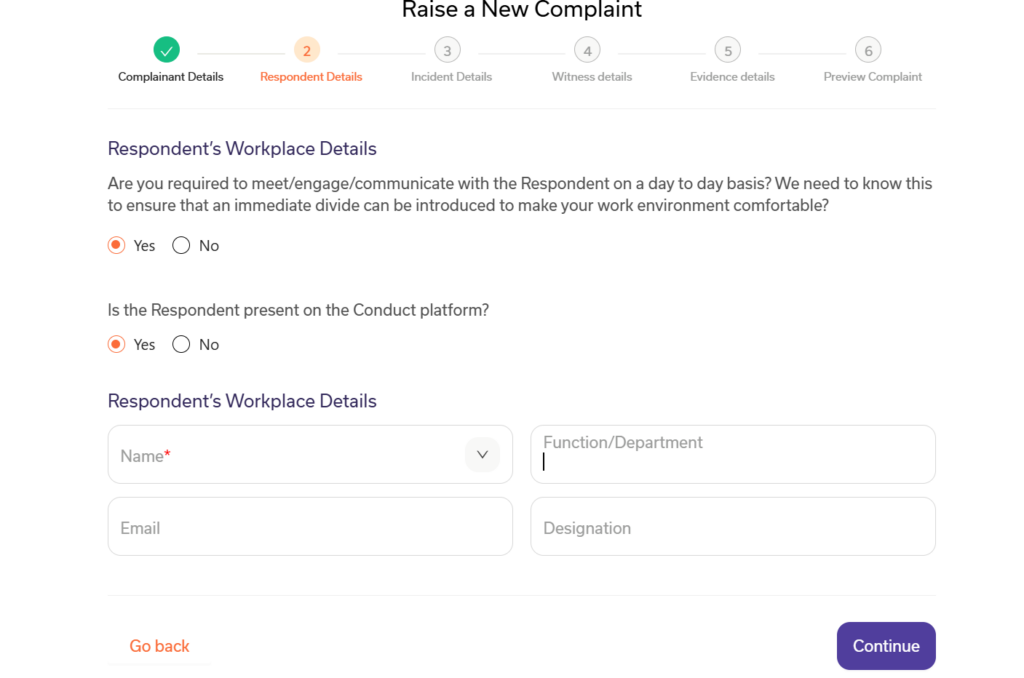
Through Conduct, complaints can be raised and investigated in a single, secure process that cuts across departments, designations, and organisational boundaries, ensuring that procedural complexity never becomes a barrier to safety, due process, or justice for the complainant.
See Conduct’s Complaint Mechanism:


Backed by enterprise-grade security and compliance
Your sensitive workplace data deserves the highest level of protection. We maintain rigorous security standards and compliance certifications to ensure your organization's information remains secure, confidential, and audit-ready.
View Security Center