
Ensuring Fair Process on Both Sides: Respondent Rights in PoSH Inquiries
In PoSH inquiries, Internal Committees often place significant emphasis on protecting the aggrieved employee. This emphasis is necessary and rooted in the purpose of the law. However, when concern for protection begins to influence how evidence is assessed, how procedures are applied, or how parties are heard, the inquiry can unintentionally move away from neutrality….

In PoSH inquiries, Internal Committees often place significant emphasis on protecting the aggrieved employee. This emphasis is necessary and rooted in the purpose of the law. However, when concern for protection begins to influence how evidence is assessed, how procedures are applied, or how parties are heard, the inquiry can unintentionally move away from neutrality.
Such imbalance does not only affect perceptions of fairness. It directly impacts the legal strength of the inquiry. Courts examining PoSH cases focus closely on whether principles of natural justice were followed for both parties. Where respondent rights are restricted, inconsistently applied, or treated as secondary, findings are more likely to be challenged and set aside.
This article examines common ways in which bias against respondents enters PoSH inquiries, often without conscious intent. It also outlines how IC members can conduct inquiries that remain firm, fair, and procedurally sound, protecting the aggrieved while ensuring that the process itself remains defensible.
Laying the Foundation of a Fair Inquiry
A PoSH inquiry’s credibility rests on one core truth, outcomes can only be trusted if the process is fair. This fairness is anchored in two principles of natural justice: Audi Alteram Partem(hear the other side) and Nemo Judex in Causa Sua (no one should judge their own case).
Fairness means giving the respondent a genuine chance to present their version, not just a procedural checkbox. It also demands impartiality, the IC must approach each complaint without bias or pre-judgment, letting evidence guide conclusions. These are not ideals but statutory duties under the PoSH Act, making fairness a legal necessity, not a choice.
These are not aspirational standards. The PoSH framework requires inquiries to follow principles of natural justice and conduct an unbiased examination at every stage. Fairness, therefore, is a legal obligation, not a discretionary choice.
The Core Tension: Safety Without Pre-Judgment
In most PoSH inquiries, IC members feel a strong and understandable pull in one direction: protecting the aggrieved employee. That instinct is central to the purpose of the law. The difficulty arises when this concern begins to shape assumptions about the outcome, rather than the safeguards around the process.
Under the PoSH framework, the IC is required to hold two responsibilities at the same time. It must create a complaint-friendly environment, one that takes the allegation seriously, prevents further harm, and enables the aggrieved to participate without fear. At the same time, it must ensure that the respondent remains a respondent, not a presumed perpetrator, until the facts are tested through the inquiry.
This is where neutrality becomes operational rather than theoretical. Language, tone, and process choices are often the first places where pre-judgment appears. Referring to the complainant as a “victim” assumes that harm has already been established, even while the inquiry is ongoing. Calling the other party an “accused” similarly signals a conclusion that the Committee has not yet reached. The law therefore uses neutral terms, “aggrieved” or “complainant” and “respondent”, to keep the inquiry open-ended and evidence-led.
These distinctions may seem minor, but they shape how the process is experienced by both parties. When ICs maintain neutral language, share material consistently, and keep questioning measured, they reinforce a crucial message: the inquiry is a safe space to raise concerns, and a fair space in which conclusions are earned, not assumed.
Where Bias Actually Enters the Inquiry Process
Bias in PoSH inquiries is rarely obvious. IC members usually do not favour one side openly. Instead, bias creeps in through small, well-intentioned decisions which, over time, can disturb the fairness of the process.
One common point where this occurs is during the sharing of information. When respondents receive incomplete copies of the complaint, the inquiry begins to lose fairness. Courts have repeatedly emphasised that neutrality is assessed not only by what the IC ultimately considers, but by whether both parties were given timely and equal access to the same information.
This position was reinforced by the Kerala High Court in Vineeth V.V. v. Kerala State Electricity Board and Ors., where the inquiry report was set aside solely because the respondent was not served a copy of the complaint and relevant documents within the said time frame as required under the PoSH Rules. The Court held that this failure violated principles of natural justice, making the inquiry legally unsustainable. The case illustrates how even a single procedural lapse at the information-sharing stage can invalidate the entire process.
Questioning and Cross-Examination: Neutrality Under Scrutiny
During the investigation stage, cross-questioning requires particular care. This is often where assumptions harden into conclusions if the process is not tightly moderated. IC members may, without conscious intent, allow questioning to move unevenly, seeking clarification and context from the aggrieved, while pressing the respondent for justification or contradiction. Over time, this difference in approach can influence how credibility is perceived.
Judicial scrutiny has been particularly sharp on this aspect of inquiries. In Manjeet Singh v. Indraprastha Gas, the Delhi High Court set aside the findings of an Internal Complaints Committee on the ground that the respondent was denied a proper opportunity to cross-examine the complainant. The Court emphasised that cross-examination is not a discretionary courtesy but a component of natural justice, and that it must be conducted in a structured, written manner rather than through informal or verbal exchanges. Importantly, the judgment underscored the need to protect the dignity and reputation of individuals against whom allegations are made, especially where findings are not corroborated by independent evidence.
The IC’s responsibility during cross-questioning is to act as a procedural gatekeeper. Questions must remain focused on facts, timelines, and relevance, rather than drifting into moral evaluation or character assessment. When cross-questioning is allowed to become informal, leading, or unevenly controlled, the inquiry risks shifting from fact-finding to fault-finding, weakening both its fairness and its defensibility.
Interim Relief: Protection, Not Punishment
Interim relief under the PoSH framework is meant to provide immediate protection during an ongoing inquiry, not to signal guilt. Its purpose is limited: to prevent further harm, retaliation, or misuse of power while facts are being examined.
Section 12 of the PoSH Act allows the IC, on a written request from the aggrieved woman, to recommend measures such as temporary transfer, paid leave, or other steps necessary to ensure safety and dignity. These measures are discretionary and must be proportionate to the situation.
Problems arise when interim relief begins to function as a penalty. For ICs, the task is to reduce risk without deciding the case in advance.
Recording Findings: Where Fairness Becomes Visible
Bias is most often revealed not in decision-making, but in how decisions are recorded.Reports that give disproportionate weight to one party’s account without explaining how evidence was assessed, or that overlook inconsistencies on the more persuasive side, weaken their own conclusions.
Recording inquiry findings under the PoSH Act requires ICs to document both parties’ versions, explain evidence assessment, and demonstrate reasoned credibility evaluations to uphold natural justice and avoid bias. Courts have invalidated reports lacking this rigor, emphasizing that bias, actual or apparent, vitiates proceedings.
The PoSH Act demands comprehensive reporting that records proceedings, evidence, and findings without disproportionate weighting of accounts. ICs must evaluate credibility through consistency, corroboration, and plausibility, documenting rationale to show conclusions stem from analysis, not assumption.
In the landmark judgement of Manjeet Singh vs. Indrapastha Gas Limited, in the High Court of Delhi, W.P.(C) 6352/2016), stated that though the principles of natural justice have many shades, one of its basic tenets is that one must pass a reasoned order i.e. the order must have a valid basis which needs to be incorporated in the inquiry report.
A sound report records both versions, explains how credibility was evaluated, and shows that conclusions were reached through reasoned analysis rather than assumption. Seen this way, bias is not about intent. Mapping the process end to end helps IC members identify where neutrality can slip and where it must be consciously reinforced.
PoSH inquiries hinge on human discernment: attentive listening, weighing contradictions, and determining fairness among colleagues who continue working together.
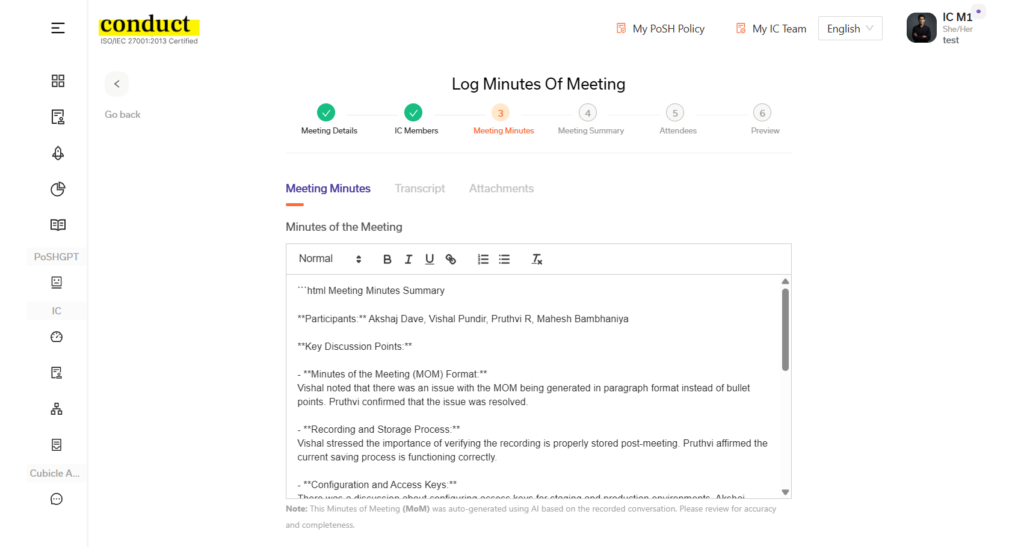
Technology cannot supplant this judgment but excels at handling procedural and documentation burdens that divert ICs from core reasoning. Platforms like Conduct’s case management streamline logging timelines, evidence trails, and rationales, enabling focus on nuanced assessments without compromising independence. This aligns with natural justice mandates under Section 13, ensuring reports withstand scrutiny. See how Conduct’s case management supports ICs without intruding on judgment →
When the process is fair, both the outcome and the institution carrying it forward remain credible.
Key takeaways
- Protecting the aggrieved employee is essential, but when that concern starts shaping how evidence is assessed or how the respondent is treated, the inquiry risks losing its legal credibility.
- Equal access to information, a genuine opportunity to be heard, and impartial evaluation of evidence are statutory obligations under the PoSH Act. Even minor procedural lapses can invalidate an otherwise well-intentioned inquiry.
- Courts scrutinise how conclusions are reached, not just what they conclude. Reasoned reporting, balanced documentation of both versions, and structured inquiry practices are essential to ensuring findings withstand judicial review.
Subscribe for insights that matter
Related Articles